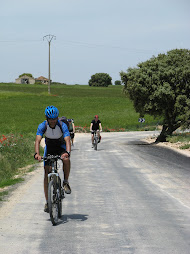
In addition to being one of my favourite cyclists, David Zabriskie, of the Garmin-Chipotle squad, is also one of my favourite bloggers. Read Dave's blog, when he's got the chance to update it, and you get an untarnished, no-holds-barred look in on the world of cycling - the last entry, at www.davezabriskie.com, is a heartbreaking look at what happened during and after he crashed out of the 2008 Giro.
Yep, you read that right. LAST entry. As in, not long after fracturing his 1st vertebrae, his wife gave birth to a baby boy and then there were the small matters of the Tour de Missouri and the Worlds in Varese, which means that DZ's attention, to put it mildly, has been slightly fractured. So I'd keep on checking out his website, hoping to find a new blog entry or piece of information, some nugget of wisdom, and realize that the final thing he'd put down was the run-down of his return from Italy.
And then I'd think, oh boy, he's not the only one........
So this weekend, in addition to taking Ellie out (you'll read about Ellie below - she's the other reason I'm somewhat house-bound and not able to do much beyond pottering about the new apartment, riding and writing), I'm going to catch up on all of the blog entries I should have written (and did, in some cases...just in other blogs) so that the last six months accurately reflect everything which has happened - getting into road cycling, the Trans-Iberian Express, and other things.
Stay tuned...much more coming up!
Friday, October 3, 2008


Why there aren't more female cyclists (Part I)
This morning, Carlos Sastre, the 2008 winner of the Tour de France, had a cyber-chat with the readers of the Spanish sports newspaper, MARCA. One of the reasons why Carlos became a cyclist was the effort his father, Víctor Sastre, who started a sports foundation in the town of El Barraco. According to Sastre Senior, drugs were a big problem in the town in the 80s, and sports (especially cycling, of which the elder Sastre was once a practicioner) seemed to be one of the main ways out. And to this day, the Fundación Víctor Sastre trains kids to be competitive cyclists...and the website says that some thirty boys and girls currently take part in the program.
Given that the thought of traning and developing up-and-coming cyclists should not be that alien to either of the Sastre men, then, I put forward the following question (somewhat abbreviated because I wasn't able to save what I wrote):
Hello Carlos:
Congratulations on an outstanding season. I recently took a look at the webpage of the Foundation in El Barraco and I noticed that you've got a number of girls who are taking part in the program. I was wondering if you have any opinions about why there are so few women who ride professionally in Spain and who continue as they get older.
It's probably not surprising that he didn't take that one on: firstly, because he probably has very little to do with the Foundation (aside from giving the occasional pep talk) and secondly, because cyclists, like a lot of athletes, are not really given to deep reflection on things that do not fall within their scope of interests. Sastre isn't alone in this respect: Alberto Contador's Televisión Española blog from the 2008 Olympics (which is no longer available on the RTVE website) only has two mentions of his female companions - Maribel Moreno, who got sent back to Spain after testing positive for EPO; and Leire Olaberria, who took home a bronze medal in track. In both cases, Contador's second sentence was "I don't know [said cyclist], but....."
Admittedly, there's no geographical reason why these cyclists should know each other (Leire's Basque and Maribel is from Valencia) but it made me wonder why the national cycling teams couldn't have, at least, had dinner or gone for drinks or some such thing before heading off for Beijing. It's not like there are tons of women cyclists racing in Spain: this list gives the ranking of the 44, count 'em, 44 Spanish women and their national rankings. I should point out that not every cyclist on this list races in Spain: Eneritz Iturriaga is currently riding as a pro in Italy. (To see the most current list of Spanish women's road rankings, click on this link: http://rfec.trackglobe.com/familias/INDIVIDUAL%2022-09-082.pdf
I've been thinking about this a lot in the last couple of years, but I had two moments of clarity yesterday, especially after my credit card rebelled in Calmera as I tried to buy a new odometer for Ellie:
a) COMPETITIVE ROAD CYCLING IS EXPENSIVE. Not just expensive - bloody expensive. A decent bike will run you at least €1500 (and that's for an Orbea, which is produced in Navarre.) A 2008 road licence is €52. Then there's the kit, the expense of getting to and from races, entry fees for races... The RFEC is trying to combat this by offering grants to cadets and sub-23s and their families, but if it's like trying to get ANY grant in Spain, it'll involve a ton of paperwork and ultimately not be worth the pittance you'll get. As they say in Spain, water that's gone under the bridge can't move the mill.
b) COMPETITIVE ROAD CYCLING REQUIRES A LOT OF FAMILY SUPPORT, or a lack of emotional and work obligations so that you're able to focus on the stupid stuff, like being able to cook healthy, nutritional meals for yourself, to be able to shop regularly, to have someone to talk to. I used to think that male cyclists were insane for getting married so young; now I see that having someone on board to work as a butler, laundress, nutritionist and secretary is a very intelligent way of keeping your head out of your hands and your tears of exhaustion and frustration in your eyes.
All of which doesn't mean that it's not worth trying to race - but it does require the ability to keep your head on straight, to know what your priorities are and knowing what you want. And that's not necessarily something that most young women are able to do easily.
ººººººººººººººººººººººººººººººººººººº
Stupid Piece of Trivia for the Day: One of the possible translations of the name Carlos Sastre is Chuck Taylor. As far as I've been able to find out, the cyclist from Ávila is not a b-ball player, and he has yet to be seen in a pair of high-tops.
ººººººººººººººººººººººººººººººººººººº
If your Spanish is up for it (and judging by the calibre of questions, you don't need a particularly high level of fluency), the Q&A is still available online at http://www.marca.com/charlas/carlos-sastre/03102008.html
Given that the thought of traning and developing up-and-coming cyclists should not be that alien to either of the Sastre men, then, I put forward the following question (somewhat abbreviated because I wasn't able to save what I wrote):
Hello Carlos:
Congratulations on an outstanding season. I recently took a look at the webpage of the Foundation in El Barraco and I noticed that you've got a number of girls who are taking part in the program. I was wondering if you have any opinions about why there are so few women who ride professionally in Spain and who continue as they get older.
It's probably not surprising that he didn't take that one on: firstly, because he probably has very little to do with the Foundation (aside from giving the occasional pep talk) and secondly, because cyclists, like a lot of athletes, are not really given to deep reflection on things that do not fall within their scope of interests. Sastre isn't alone in this respect: Alberto Contador's Televisión Española blog from the 2008 Olympics (which is no longer available on the RTVE website) only has two mentions of his female companions - Maribel Moreno, who got sent back to Spain after testing positive for EPO; and Leire Olaberria, who took home a bronze medal in track. In both cases, Contador's second sentence was "I don't know [said cyclist], but....."
Admittedly, there's no geographical reason why these cyclists should know each other (Leire's Basque and Maribel is from Valencia) but it made me wonder why the national cycling teams couldn't have, at least, had dinner or gone for drinks or some such thing before heading off for Beijing. It's not like there are tons of women cyclists racing in Spain: this list gives the ranking of the 44, count 'em, 44 Spanish women and their national rankings. I should point out that not every cyclist on this list races in Spain: Eneritz Iturriaga is currently riding as a pro in Italy. (To see the most current list of Spanish women's road rankings, click on this link: http://rfec.trackglobe.com/familias/INDIVIDUAL%2022-09-082.pdf
I've been thinking about this a lot in the last couple of years, but I had two moments of clarity yesterday, especially after my credit card rebelled in Calmera as I tried to buy a new odometer for Ellie:
a) COMPETITIVE ROAD CYCLING IS EXPENSIVE. Not just expensive - bloody expensive. A decent bike will run you at least €1500 (and that's for an Orbea, which is produced in Navarre.) A 2008 road licence is €52. Then there's the kit, the expense of getting to and from races, entry fees for races... The RFEC is trying to combat this by offering grants to cadets and sub-23s and their families, but if it's like trying to get ANY grant in Spain, it'll involve a ton of paperwork and ultimately not be worth the pittance you'll get. As they say in Spain, water that's gone under the bridge can't move the mill.
b) COMPETITIVE ROAD CYCLING REQUIRES A LOT OF FAMILY SUPPORT, or a lack of emotional and work obligations so that you're able to focus on the stupid stuff, like being able to cook healthy, nutritional meals for yourself, to be able to shop regularly, to have someone to talk to. I used to think that male cyclists were insane for getting married so young; now I see that having someone on board to work as a butler, laundress, nutritionist and secretary is a very intelligent way of keeping your head out of your hands and your tears of exhaustion and frustration in your eyes.
All of which doesn't mean that it's not worth trying to race - but it does require the ability to keep your head on straight, to know what your priorities are and knowing what you want. And that's not necessarily something that most young women are able to do easily.
ººººººººººººººººººººººººººººººººººººº
Stupid Piece of Trivia for the Day: One of the possible translations of the name Carlos Sastre is Chuck Taylor. As far as I've been able to find out, the cyclist from Ávila is not a b-ball player, and he has yet to be seen in a pair of high-tops.
ººººººººººººººººººººººººººººººººººººº
If your Spanish is up for it (and judging by the calibre of questions, you don't need a particularly high level of fluency), the Q&A is still available online at http://www.marca.com/charlas/carlos-sastre/03102008.html
Wednesday, July 2, 2008
Still "Haulin' Anchor" with Radio Euskadi
Very few people are as up on the movements of Spanish travellers as Roge Blasco is. Roge is the host of "Levando Anclas" on Radio Euskadi, the Basque regional radio station; and during the Trans-Iberian, we chatted on a weekly basis about how it was going and what the challenges were.
About a month back, we had a chat (in Spanish) that sort of summarized the entire trip, and it was funny to hear the recordings that he'd made and to think back to when we were doing the trip, trying to keep the panic out of my voice as we got blasted by every storm imaginable.
As I mentioned, the interview is going to be in Spanish, and I don't know if it's going to be broadcast over the internet...but here's the entry about the interview, in Roge's blog:http://blog.eitb.com/rogeblasco/2008/07/01/levando-anclas-13-de-julio-caballos-y-ch/.
"Levando Anclas" is broadcast on Radio Euskadi every Sunday night at 9PM.
About a month back, we had a chat (in Spanish) that sort of summarized the entire trip, and it was funny to hear the recordings that he'd made and to think back to when we were doing the trip, trying to keep the panic out of my voice as we got blasted by every storm imaginable.
As I mentioned, the interview is going to be in Spanish, and I don't know if it's going to be broadcast over the internet...but here's the entry about the interview, in Roge's blog:http://blog.eitb.com/rogeblasco/2008/07/01/levando-anclas-13-de-julio-caballos-y-ch/.
"Levando Anclas" is broadcast on Radio Euskadi every Sunday night at 9PM.
Saturday, June 14, 2008
The Grass is always greener in someone else's cracked pavement...
Even though I haven't lived in Toronto for nearly ten years, and have no intention whatsoever of returning to live in Canada, I still subscribe to "Cyclometer", the e-newsletter put out by the City of Toronto's municipal cycling department. Stacy, the coordinator, is a wealth of information about cycling and urban mobility policy, and it's inspiring to see the way cycling is taking off in Toronto and other North American cities....
Then, yesterday afternoon, I opened the latest version of "Cyclometer", and saw this:
There are a number of theories for why cycling in Europe is both safer and more popular than in North America. One theory relates to transportation infrastructure: European cities most often feature cycle paths separated from motorized traffic, while Canadian cyclists are more likely to be sharing the road with parked and moving cars. "The relative safety of these two styles of infrastructure has been the subject of much debate among cycling researchers and advocates, but little research," explains Teschke.
Now, to be fair, there is one mention, in the first part of the announcement, that both the University of Toronto and the University of British Columbia are going to conduct research into cycling safety in NORTHERN Europe, not Europe as a whole. It strikes me as facile to assume that things are better on this side of the ocean than they are in Vancouver or Toronto or wherever.
I'm not aware, for example, of any European city where cyclists don't have to rely on road riding to get around. In Madrid, we have a decent cyclepath that rings the city, but only two which take you east-west - and both of those are less than a kilometre long. Until the so-called Green Ring was built, Madrid had 60 km of bike trails, and 30 kilometres of those were to take you up out of the city, to the Sierra. Never mind the fact that you needed a car to get to the trailhead. And getting grannies, small dogs and kids off the bike trails? Yet I still get a chorus of "Oh, you live in Spain. What with Contador and Indurain, things must be great for cyclists there." Well, maybe. Contador lives in suburbia and Indurain's Basque. And neither of them use their Treks to get the morning paper, you wanna bet.
I know that things really aren't that better in other cities, either. Reading the CYCLOTHERAPY blog on The Independent's website, for example, doesn't give me the sense that things are much different in London. Julián Illara, the coordinator of Burgos en Bici, recently came back from a cycling conference in Rome and told me of being horrified at ending up on a six-lane motorway during Rome's Critical Mass late last month. Rome cyclists are so pissed off at being marginalized that they have no problem doing what they can to screw up traffic.
If the UN is so worried about climate change, I have an idea: start a Directorate of Alternate Transport. Instead of spending money on allowing the sons of third-world despots to live the high life in Manhattan, let's take some of that dosh and start a library/website/information office/whatever that allows cycling organizations, academic bodies, government organizations or whoever to share information, policy, research, whatever.
But don't let's make the mistake of assuming that eveything that's not where we are is brilliant and good. It's a common enough refrain here... "Oh, but everything is so much easier for cyclists in Amsterdam...in Northern Europe....in Denmark...in Chicago...whatever." It isn't.
It's the same mindgame that makes people assume that if they can't reach perfection, it's not worth the effort to even try in the first place. We all work with what we've got. We can learn from others, but we can't be them.
Then, yesterday afternoon, I opened the latest version of "Cyclometer", and saw this:
There are a number of theories for why cycling in Europe is both safer and more popular than in North America. One theory relates to transportation infrastructure: European cities most often feature cycle paths separated from motorized traffic, while Canadian cyclists are more likely to be sharing the road with parked and moving cars. "The relative safety of these two styles of infrastructure has been the subject of much debate among cycling researchers and advocates, but little research," explains Teschke.
Now, to be fair, there is one mention, in the first part of the announcement, that both the University of Toronto and the University of British Columbia are going to conduct research into cycling safety in NORTHERN Europe, not Europe as a whole. It strikes me as facile to assume that things are better on this side of the ocean than they are in Vancouver or Toronto or wherever.
I'm not aware, for example, of any European city where cyclists don't have to rely on road riding to get around. In Madrid, we have a decent cyclepath that rings the city, but only two which take you east-west - and both of those are less than a kilometre long. Until the so-called Green Ring was built, Madrid had 60 km of bike trails, and 30 kilometres of those were to take you up out of the city, to the Sierra. Never mind the fact that you needed a car to get to the trailhead. And getting grannies, small dogs and kids off the bike trails? Yet I still get a chorus of "Oh, you live in Spain. What with Contador and Indurain, things must be great for cyclists there." Well, maybe. Contador lives in suburbia and Indurain's Basque. And neither of them use their Treks to get the morning paper, you wanna bet.
I know that things really aren't that better in other cities, either. Reading the CYCLOTHERAPY blog on The Independent's website, for example, doesn't give me the sense that things are much different in London. Julián Illara, the coordinator of Burgos en Bici, recently came back from a cycling conference in Rome and told me of being horrified at ending up on a six-lane motorway during Rome's Critical Mass late last month. Rome cyclists are so pissed off at being marginalized that they have no problem doing what they can to screw up traffic.
If the UN is so worried about climate change, I have an idea: start a Directorate of Alternate Transport. Instead of spending money on allowing the sons of third-world despots to live the high life in Manhattan, let's take some of that dosh and start a library/website/information office/whatever that allows cycling organizations, academic bodies, government organizations or whoever to share information, policy, research, whatever.
But don't let's make the mistake of assuming that eveything that's not where we are is brilliant and good. It's a common enough refrain here... "Oh, but everything is so much easier for cyclists in Amsterdam...in Northern Europe....in Denmark...in Chicago...whatever." It isn't.
It's the same mindgame that makes people assume that if they can't reach perfection, it's not worth the effort to even try in the first place. We all work with what we've got. We can learn from others, but we can't be them.
Friday, June 6, 2008
It's all right if it sucks.
One of the things that kept me riding (and sane) throughout the trip was my weekly chat with Roge Blasco.
Roge is the host of two renowned radio shows about travel, La Casa de las Palabras (The House of Words) and Levando Anclas (Hoisting Anchor) on Radio Euskadi, the Basque regional broacasting network. At the end of every week, after 9:30 in the evening, we'd talk for ten or fifteen minutes about how the trip was going. No one in Spain is as up on the movements of travellers as Roge is: you name the means of transport or the country, he knows someone who's been there and done that, but there's always a note of enthusiasm and jealousy when he interviews you. It's like at any moment you expect him to say, "Gimme a couple of hours, and I'll be there..." and for him to slam down the phone and show up at your hotel before sundown.
Yesterday we did a taping for an edition of Levando Anclas which will be broadcast in July, and Roge brought up the fact that a lot of the problems that we had on the trip were weather-related. And I thought about something that I read last week, which makes all the more sense now that I've got some space to reflect on the trip.
CNN correspondent Anderson Cooper is the cover story on this month's edition of OUTSIDE magazine and has been a reader of the magazine for decades. When he was 19, he was inspired by the article to take a trip across Africa, and from there went on to be one of the channel's best-travelled journalists. For copyright reasons I can't clip the particular question and answer that moved me, but if you click here(http://outside.away.com/outside/culture/200805/anderson-cooper-2.html) and do a search for "It's supposed to suck", you'll see which one I mean.
It was a great relief to read this. It was a relief to see someone else say that it was all right if the trip didn't go perfectly, if the weather sucked or you realized that you were generally a lot happier when your travel companion went off on his own and you didn't see him for three days. It was all right to be awake at night, normally at 12:03 AM, obsessing about whether someone was going to steal your bike and leave you stranded in some lost town in Soria. (Funny, I never obsessed about breaking my neck - but the thought that someone would nick Ruby gave me more than one sleepless night.)
And Mr. Cooper is right. You learn a lot more about your own limits and your own sense of possibilities when things don't go perfectly. If you don't have adversity, you don't learn how strong you actually are, how resourceful you are and that it's all right to be alone. A woman travelling alone is not an automatic target for all the evil and crime in the world. As women we receive messages, consciously or unconsciously, that if we go down into the woods today, we're going to end up dead in a ditch somewhere, that we're just asking to be raped or attacked or God knows what. (I should get my mother to fill this part in.)
That doesn't mean that we shouldn't take precautions. But fear has limited value when undertaking something like this. If you're too fearful, everything is going to seem like a threat, rather than just crap that happens to everyone.
You don't get bad weather because you're a woman travelling alone.
You don't get pelted by hail because you're a woman travelling alone.
Sometimes it is going to suck. You just can't take it personally.
You shrug it off, you learn, and you keep your head down and keep going.
Roge is the host of two renowned radio shows about travel, La Casa de las Palabras (The House of Words) and Levando Anclas (Hoisting Anchor) on Radio Euskadi, the Basque regional broacasting network. At the end of every week, after 9:30 in the evening, we'd talk for ten or fifteen minutes about how the trip was going. No one in Spain is as up on the movements of travellers as Roge is: you name the means of transport or the country, he knows someone who's been there and done that, but there's always a note of enthusiasm and jealousy when he interviews you. It's like at any moment you expect him to say, "Gimme a couple of hours, and I'll be there..." and for him to slam down the phone and show up at your hotel before sundown.
Yesterday we did a taping for an edition of Levando Anclas which will be broadcast in July, and Roge brought up the fact that a lot of the problems that we had on the trip were weather-related. And I thought about something that I read last week, which makes all the more sense now that I've got some space to reflect on the trip.
CNN correspondent Anderson Cooper is the cover story on this month's edition of OUTSIDE magazine and has been a reader of the magazine for decades. When he was 19, he was inspired by the article to take a trip across Africa, and from there went on to be one of the channel's best-travelled journalists. For copyright reasons I can't clip the particular question and answer that moved me, but if you click here(http://outside.away.com/outside/culture/200805/anderson-cooper-2.html) and do a search for "It's supposed to suck", you'll see which one I mean.
It was a great relief to read this. It was a relief to see someone else say that it was all right if the trip didn't go perfectly, if the weather sucked or you realized that you were generally a lot happier when your travel companion went off on his own and you didn't see him for three days. It was all right to be awake at night, normally at 12:03 AM, obsessing about whether someone was going to steal your bike and leave you stranded in some lost town in Soria. (Funny, I never obsessed about breaking my neck - but the thought that someone would nick Ruby gave me more than one sleepless night.)
And Mr. Cooper is right. You learn a lot more about your own limits and your own sense of possibilities when things don't go perfectly. If you don't have adversity, you don't learn how strong you actually are, how resourceful you are and that it's all right to be alone. A woman travelling alone is not an automatic target for all the evil and crime in the world. As women we receive messages, consciously or unconsciously, that if we go down into the woods today, we're going to end up dead in a ditch somewhere, that we're just asking to be raped or attacked or God knows what. (I should get my mother to fill this part in.)
That doesn't mean that we shouldn't take precautions. But fear has limited value when undertaking something like this. If you're too fearful, everything is going to seem like a threat, rather than just crap that happens to everyone.
You don't get bad weather because you're a woman travelling alone.
You don't get pelted by hail because you're a woman travelling alone.
Sometimes it is going to suck. You just can't take it personally.
You shrug it off, you learn, and you keep your head down and keep going.
Tuesday, March 18, 2008
The Adventure Begins
Well, whatever. Whatever isn't done can be mocked up, ad-libbed, put into order or taken care of at a later date. I got to Chamartín Station without too much difficulty except that the bike, fully packed, is quite heavy, so.........
8:29 - Shortly before the train took off, a guy got on the train with a LeMond ten-speed that had to be a good ten years old. Looks like he's heading up to Ávila. I think he's gonna be disappointed. There's rain in them thar hills. LOTS of rain.
14.17 - Good stuff. Turns out that the train I took DOES go all the way up to Irún, which means that it also goes by Ordizia, where Stuart and Jools live. Hur-RAH, as my host would say. The train going up from Vitoria is full of university students, and quite a number of them are speaking in Euskera, which sounds comforting when they speak it. Now that I just hope that one of them doesn't put his or her bike (all of their bikes are made by Orbea, not surprisingly) against mine, so that I can get off more easily in Ordizia.
I love the Basque Country. Everything's so tidy and orderly up here. And there are so many bidegorris (bicycle lanes), making it easier to get around by bike. Three of the students on this train have brought their bikes and they just fling 'em on the train without any ado - bang! and on they go.
18:33 - If it stays like this for the rest of the weekend, we'll have gotten off lightly, that's for sure. It's a heavy mist, more than anything, and Stuart seems to think that the odds of having an epic, ripping boomer worthy of King Lear is pretty minimal. He said that last weekend they were supposed to get snow and instead they ended up sitting around watching the rugby match in their shirtsleeves. So who knows.
8:29 - Shortly before the train took off, a guy got on the train with a LeMond ten-speed that had to be a good ten years old. Looks like he's heading up to Ávila. I think he's gonna be disappointed. There's rain in them thar hills. LOTS of rain.
14.17 - Good stuff. Turns out that the train I took DOES go all the way up to Irún, which means that it also goes by Ordizia, where Stuart and Jools live. Hur-RAH, as my host would say. The train going up from Vitoria is full of university students, and quite a number of them are speaking in Euskera, which sounds comforting when they speak it. Now that I just hope that one of them doesn't put his or her bike (all of their bikes are made by Orbea, not surprisingly) against mine, so that I can get off more easily in Ordizia.
I love the Basque Country. Everything's so tidy and orderly up here. And there are so many bidegorris (bicycle lanes), making it easier to get around by bike. Three of the students on this train have brought their bikes and they just fling 'em on the train without any ado - bang! and on they go.
18:33 - If it stays like this for the rest of the weekend, we'll have gotten off lightly, that's for sure. It's a heavy mist, more than anything, and Stuart seems to think that the odds of having an epic, ripping boomer worthy of King Lear is pretty minimal. He said that last weekend they were supposed to get snow and instead they ended up sitting around watching the rugby match in their shirtsleeves. So who knows.
Friday, February 8, 2008
How do you know when you're ready to go?
SIGNS THAT YOU NEED TO GO ON YOUR CYCLING VACATION NOW:
a) You live in a 20-square-metre studio apartment and you start thinking, Hm. Rather roomy, this.
b) You've sworn at the noisy neighbors once today. You've sworn at your laptop three dozen times. And it's only two in the afternoon.
b) The manager of your gym complains that you've worn out two static bicycles since Christmas.
d) You're cooking on your Campingaz stove for the sheer hell of it.
e) You're using your camping towel for the sheer hell of it.
f) You find yourself spending far more time than usual in the dried-pasta-and-soup section of the supermarket.
g) You can't find anything wrong with the idea of spreading cream cheese with your index finger.
g) The only clothes you find you wash on a regular basis are black, black, dark brown, washed-out-black-going-to-grey and the occasional red garment (for visibility, natch).
Right, then...what have I missed?
a) You live in a 20-square-metre studio apartment and you start thinking, Hm. Rather roomy, this.
b) You've sworn at the noisy neighbors once today. You've sworn at your laptop three dozen times. And it's only two in the afternoon.
b) The manager of your gym complains that you've worn out two static bicycles since Christmas.
d) You're cooking on your Campingaz stove for the sheer hell of it.
e) You're using your camping towel for the sheer hell of it.
f) You find yourself spending far more time than usual in the dried-pasta-and-soup section of the supermarket.
g) You can't find anything wrong with the idea of spreading cream cheese with your index finger.
g) The only clothes you find you wash on a regular basis are black, black, dark brown, washed-out-black-going-to-grey and the occasional red garment (for visibility, natch).
Right, then...what have I missed?
Subscribe to:
Posts (Atom)